衛星ミッション
科学衛星ミッションでは,その観測装置のいくつかが国際協力の下で開発されます.その中で,それぞれのミッションに国際的な研究者を加え,国際的な科学作業チームが形成されて,衛星計画の内容や,軌道投入後の観測運用計画の議論が行なわれます.宇宙惑星研究グループでは,実際の宇宙プロジェクトに積極的に携わることが可能です.科学衛星の運用にも参加できます.このページでは,宇宙惑星研究グループに所属する研究者・学生が貢献している衛星ミッションを紹介します.
Research & Initiatives
宇宙プラズマ研究系では数多くの探査衛星を打ち上げてきました。 現在は地球磁気圏尾部探査衛星の「ジオテイル(GEOTAIL)」や、オーロラ観測衛星の「あけぼの(EXOS-D)」、オーロラの撮像と粒子計測を同時に行う小型衛星「れいめい(INDEX)」が現役で活躍しており、毎日貴重な データを送ってきています。また、火星の上層大気の研究のために打ち上げられた火星探査機「のぞみ(PLANET-B)」でも宇宙プラズマ研究系が先導的な役割を果たしました。現在は今夏打ち上げ予定の、月探査衛星「かぐや(SELENE)」による月周辺プラズマの観測が期待されています。今後は水星探査計画 「BepiColombo」における水星磁気圏探査衛星「MMO」や、次世代の磁気圏探査衛星「SCOPE」 などの計画に向けて本格的に動き出して行くことになります。
Research & Initiatives
宇宙プラズマ研究系では数多くの探査衛星を打ち上げてきました。 現在は地球磁気圏尾部探査衛星の「ジオテイル(GEOTAIL)」や、オーロラ観測衛星の「あけぼの(EXOS-D)」、オーロラの撮像と粒子計測を同時に行う小型衛星「れいめい(INDEX)」が現役で活躍しており、毎日貴重な データを送ってきています。また、火星の上層大気の研究のために打ち上げられた火星探査機「のぞみ(PLANET-B)」でも宇宙プラズマ研究系が先導的な役割を果たしました。現在は今夏打ち上げ予定の、月探査衛星「かぐや(SELENE)」による月周辺プラズマの観測が期待されています。今後は水星探査計画 「BepiColombo」における水星磁気圏探査衛星「MMO」や、次世代の磁気圏探査衛星「SCOPE」 などの計画に向けて本格的に動き出して行くことになります。
宇宙プラズマグループ @ JAXA/ISAS


We are currently developing a mass spectrometer named TRITON for the JAXA-ISRO joint mission “LUPEX” (the Lunar Polar Exploration Mission). As part of REIWA (Resource Investigation Water Analyzer) instrument suite on LUPEX, TRITON is designed to identify the chemical composition of neutral gases produced during the lunar regolith heating performed by LTGA (Lunar Thermogravimetric Analyzer) instrument. TRITON primarily targets volatiles on the lunar surface/subsurface and is capable of measuring atoms and molecules with a mass range of 1–200 amu. It also has sufficient mass resolving power to separate adjacent peaks and quantify the abundances of species of particular interest, such as H2O.
REIWA - TRITON
🌐 日本語 / 🌐 English
Science Objectives of TRITON
Water ice is believed to be more or less “ubiquitous” on the floors of the permanently shadowed polar craters, where temperatures are extremely low due to the absence of direct sunlight and the lack of an atmosphere to transport heat. Lunar water may have originated from multiple sources and accumulated there over a long period of time. Solar wind protons (H) constantly bombard the lunar surface and can bond with oxygen (O) within lunar regolith, such as in silicate minerals, to form hydroxyl (OH) and even water molecules (H2O). In addition, the lunar surface continuously receives an influx of water molecules from external sources such as micrometeorites. The origin, transport, and accumulation of lunar H2O provide insights not only into the evolution of the Moon itself, but also into the history of the entire solar system, including the formation of Earth’s oceans. Furthermore, lunar water is an important target for in-situ resource utilization (ISRU), and it is strategically necessary to achieve ground-truth verification by directly measuring the abundance, composition, and physical state of H2O at the lunar South Pole.
The Yoshifumi Saito Lab at ISAS/JAXA, Department of Solar System Sciences, developed IMA (Ion Mass Analyzer) on Kaguya lunar orbiter, launched in 2007, to study the tenuous lunar atmosphere. While IMA is an instrument for measuring ionized particles in the lunar atmosphere, TRITON is designed to measure neutral molecules trapped within the lunar regolith. Basically, mass spectrometry is a technique that determines ion mass (m) based on F=ma by applying an electromagnetic force (F). Thus, for the TRITON project, we newly designed an ion source to convert neutral particles into positively charged ions. In addition, TRITON is designed to provide higher mass resolution than IMA, enabling the separation of H2O^+ peaks from other mass-interfering species.
Measurement Principle of TRITON
TRITON consists of several key ion-optical components: (1) an ion source for ionizing neutral particles, (2) an accelerator that boosts ion velocity using pulsed high voltages, (3) a drift chamber in which ions travel in the absence of electric and magnetic fields, (4) a reflector that reverses the ion trajectories, and (5) a detector. This is known as a time-of-flight mass spectrometer (TOF-MS) as it measures the time required for ions to travel from the accelerator to the detector; lighter ions arrive sooner, whereas heavier ions arrive later. In particular, a TOF-MS that incorporates an ion reflector is referred to as a reflectron-type mass spectrometer (Fig. 1).

Fig. 1 Schematic diagram of a reflectron-type mass spectrometer.
In fact, we have developed TRITON based on a more challenging but rewarding concept: reflecting ions not once, but three times (Triple-reflection Reflectron, from which the name “TRITON” is derived; Fig. 2). The key modification is the addition of another reflector on the ion-accelerator side (i.e., Reflector2 in Fig. 2), which enables ions to undergo two round trips before detection. Technically, this design can double the effective ion flight path, thereby improving the mass resolving power by a factor of two.
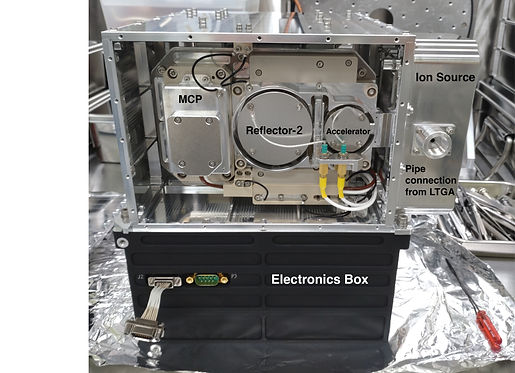

Fig. 2 An example of ion trajectories (red lines) inside TRITON, simulated by SIMION ®. The lower left area boxed in with a red dotted line is the accelerator. The blue dotted area on the right is the reflector responsible for the first and third reflections. The green dotted area on the middle-left is the reflector responsible for the second ion reflection.
Fig. 3 Photo of TRITON engineering model, showing the ion optics with part of the chassis detached.
TRITON R&D as a milestone for future planetary missions
Figure 4 illustrates the long history of mass spectrometer development in which the Yoshifumi Saito Lab has played a central role. Building on the heritage of ion mass spectrometers aboard Kaguya and the Mercury mission BepiColombo/Mio, we have been developing neutral mass spectrometers for in-situ planetary exploration, applicable to both orbiter and lander missions. Going forward, we will focus on improving performance while reducing resource requirements and costs.

Fig. 4 Legacy of spaceborne mass spectrometers developed in the Yoshifumi Saito Lab
TRITON Core R&D Team Members
Prof. Yoshifumi Saito (ISAS)
TRITON PI; management and direction; instrumentation; test and validation
Dr. Oya Kawashima (ISAS)
Instrumentation (especially ion source); test and validation
Dr. Naoaki Saito (formerly AIST)
Comprehensive design of the TRITON system
Mr. Yudai Arai (Graduate student, U. Tokyo)
Software; test and validation
Mr. Masahiro Yoneda (Graduate student, Kyoto U.)
Software; test and validation
Dr. Masaki Nishino (ISAS)
Science definition
Dr. Shoichiro Yokota (Osaka U.)
Instrumentation (especially pulsed high-voltage systems)
Dr. Satoshi Kasahara (U. Tokyo)
Instrumentation (especially ion source)
Dr. Kazushi Asamura (ISAS)
Comprehensive design of the TRITON system; test and validation